
Last updated September 10, 2026
Full 25-point door and opener safety check with every visit - springs, cables, rollers, tracks, and your LiftMaster or Chamberlain opener included
You get a price before we start. It does not change when the truck arrives.
 Before
 After
After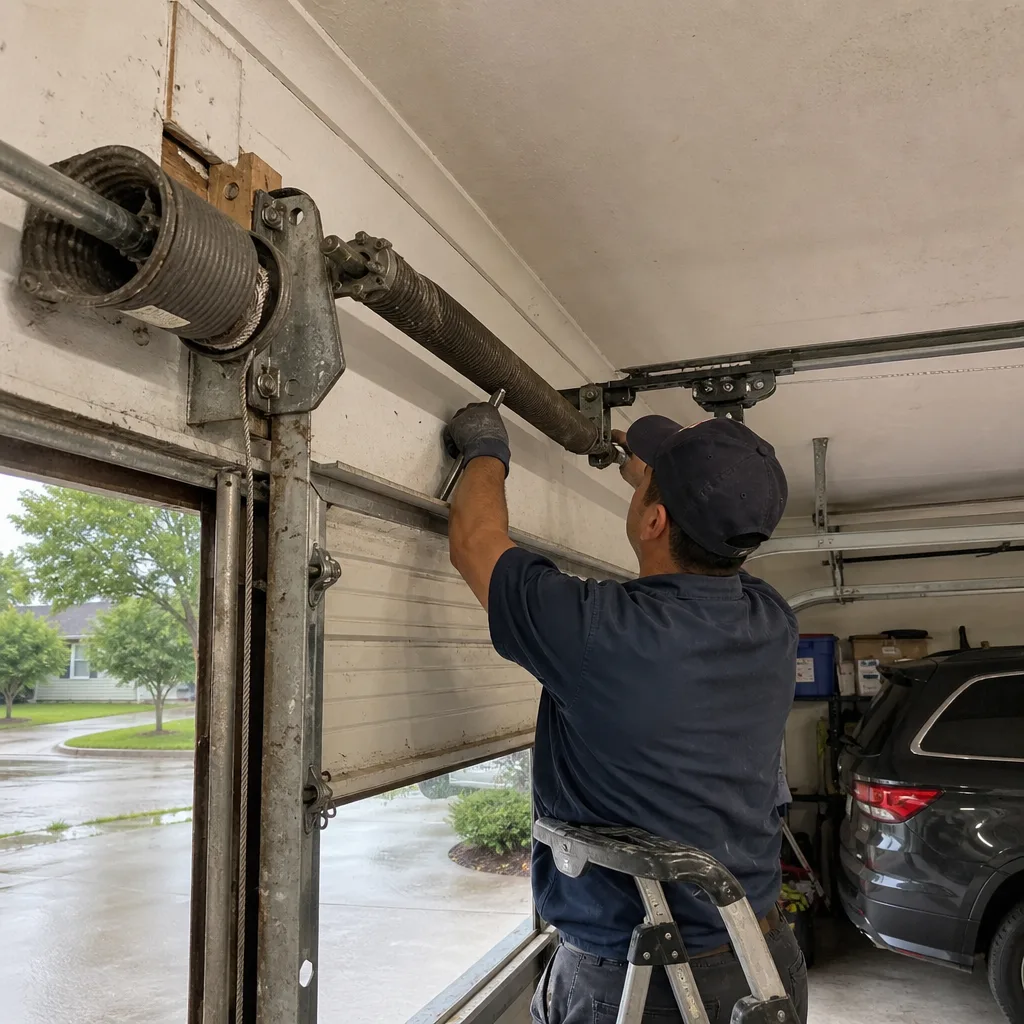 Before
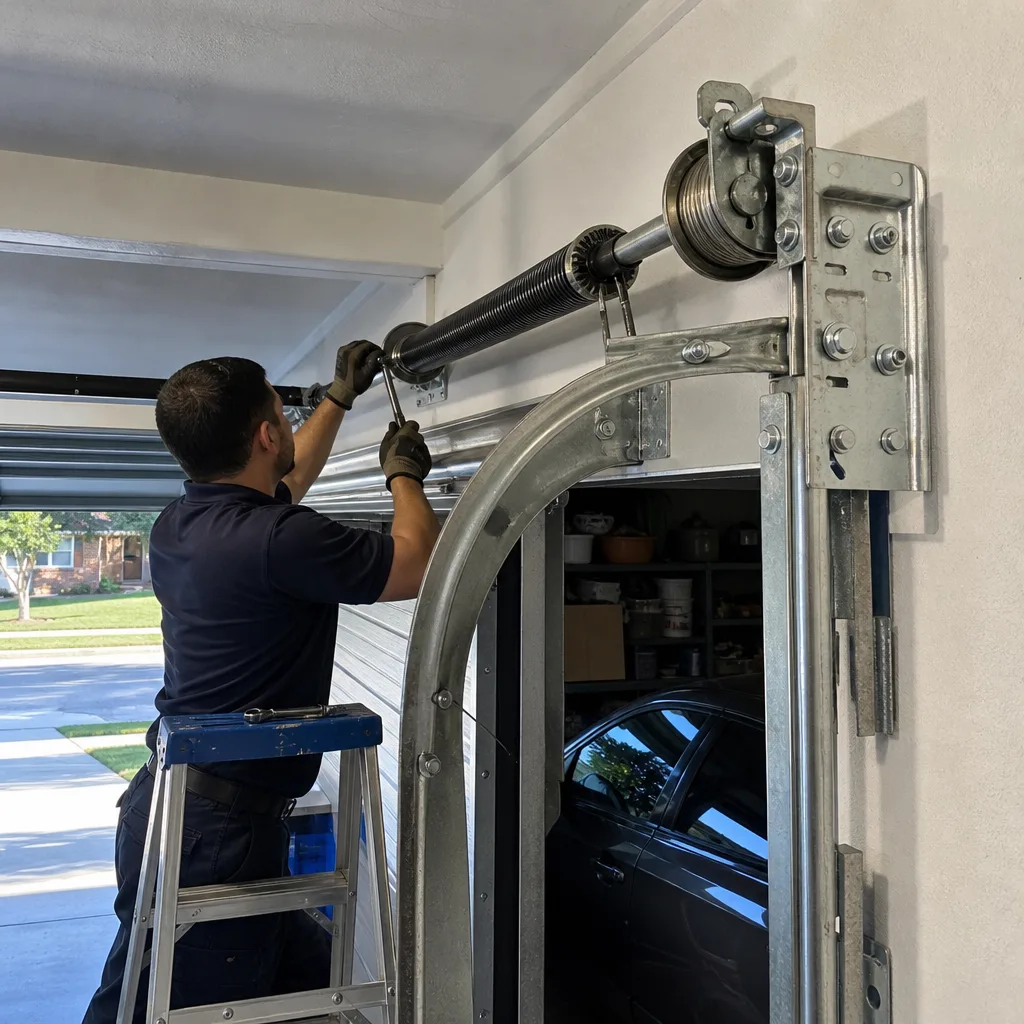 After
After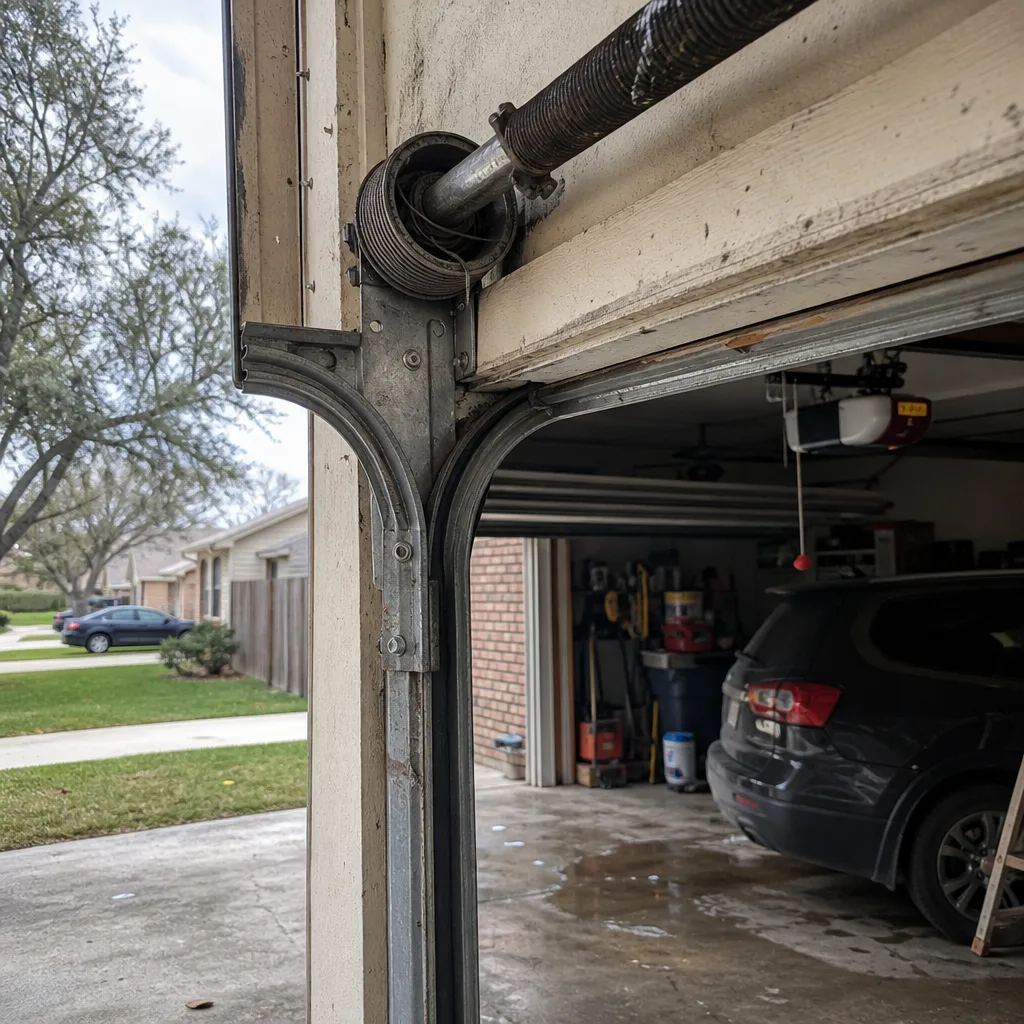 Before
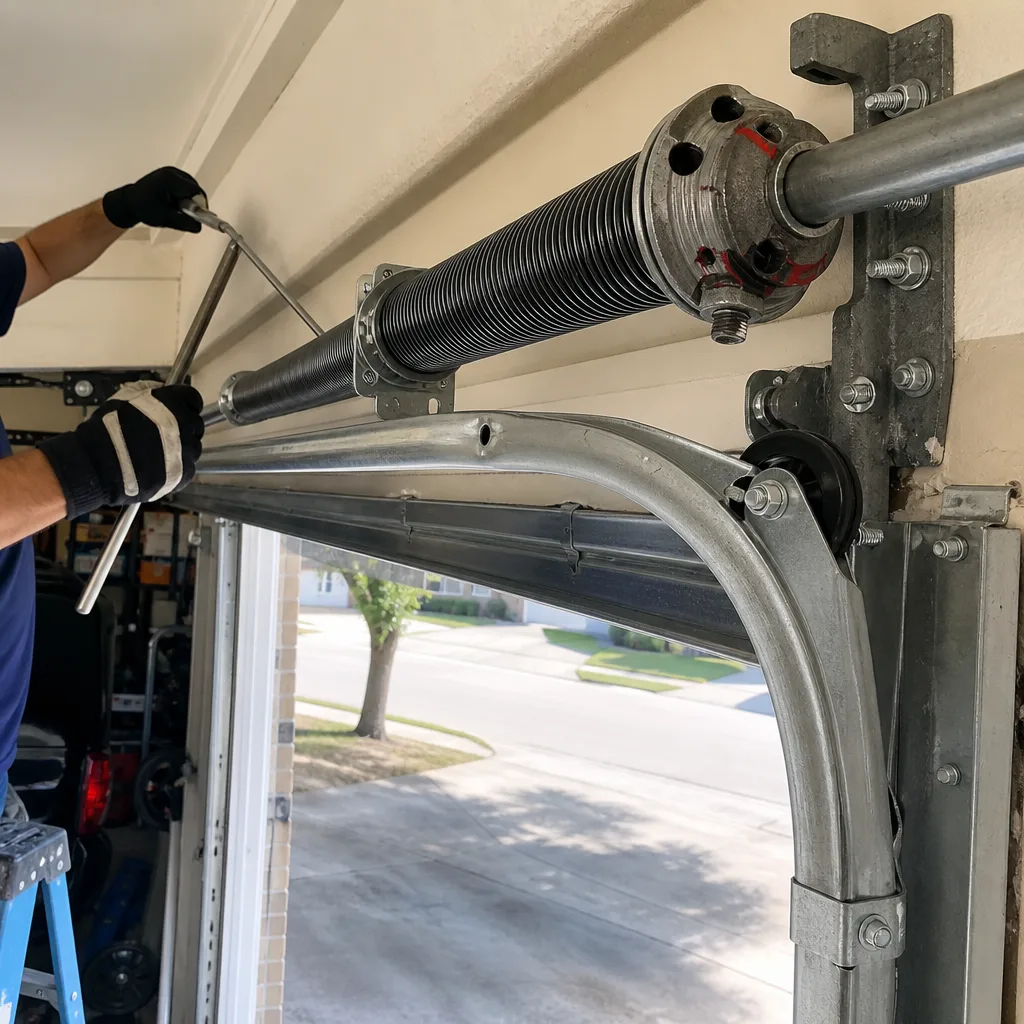 After
AfterGarage Door Warning Signs: A League City Homeowner’s Reference Guide
Most garage door failures announce themselves weeks before they become emergencies. A door that takes two button presses to close isn’t an opener quirk - it’s a safety sensor misalignment or a logic board beginning to fail, and the gap between that symptom and a stuck-open door is measured in weeks, not years. In League City, where Gulf Coast humidity accelerates rust and summer heat thickens lubricants into sludge, these warning signs progress faster than they do inland. Homeowners who learn to read the signals - or follow our Seasonal Garage Door Care for League City: Year-Round Homeowner’s Guide - avoid 6 a.m. spring snaps, missed work commutes, and security gaps that leave their garage open all night.
Quick Answer
The most critical garage door warning signs are: unusual noises (grinding, popping, or slapping), slow or uneven movement, visible rust or fraying on cables and springs, a door that reverses before closing, and gaps in the weather seal. Most of these conditions develop over 2-8 weeks before total failure. In League City’s coastal climate, rust and seal deterioration move faster than national averages due to salt air and high humidity.
Table of Contents
- The Sound Diagnostic: What Your Garage Door Is Telling You
- Visual Inspection: Rust, Wear, and Gulf Coast Damage
- Slow or Uneven Movement: Reading the Mechanics
- The Door-Reversal Test and UL 325 Safety Standards
- Weather Seal Failure: The Hidden Early Signs
- Opener and Electrical Warning Signs
- Failure Timelines and Cost Consequences of Waiting
- Common Mistakes to Avoid
- When to Call a Professional
- Frequently Asked Questions
- The Bottom Line
The Sound Diagnostic: What Your Garage Door Is Telling You
A garage door in good condition produces a steady, low rumble as it moves along the track. When that sound changes, the door is reporting a specific mechanical problem. Learning these sounds saves League City homeowners from the surprise of a door that won’t move at all.
Grinding: Metal on Metal Contact
Grinding usually means a roller has seized or a bearing has failed. The door still moves, but the roller skids instead of rolling, wearing a flat spot into the steel track. In our experience across League City neighborhoods from South Shore Harbour to Clear Creek, grinding left unaddressed destroys the track within 3-4 weeks. Track replacement runs $280-$450; a roller swap costs $120-$180. The sound is the door asking for the cheaper repair.
Popping: Torsion Spring Fatigue
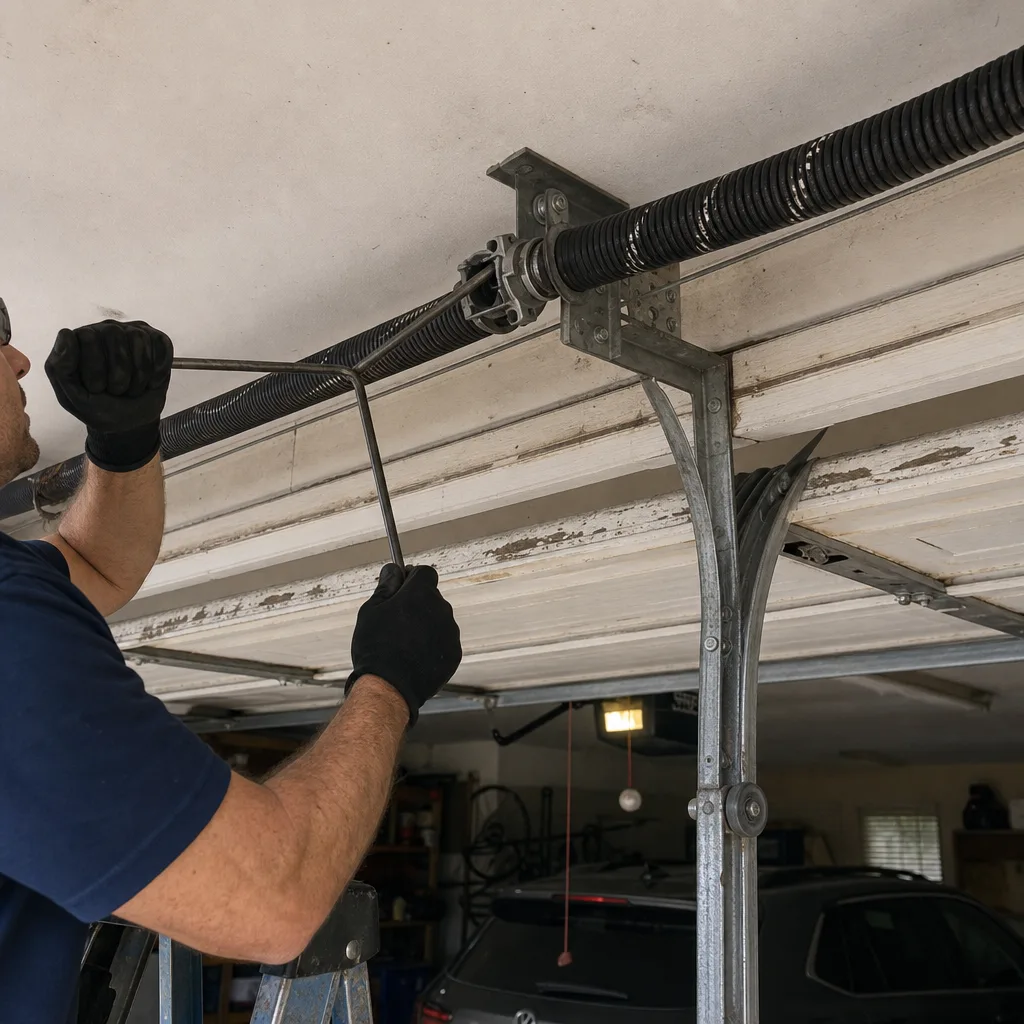
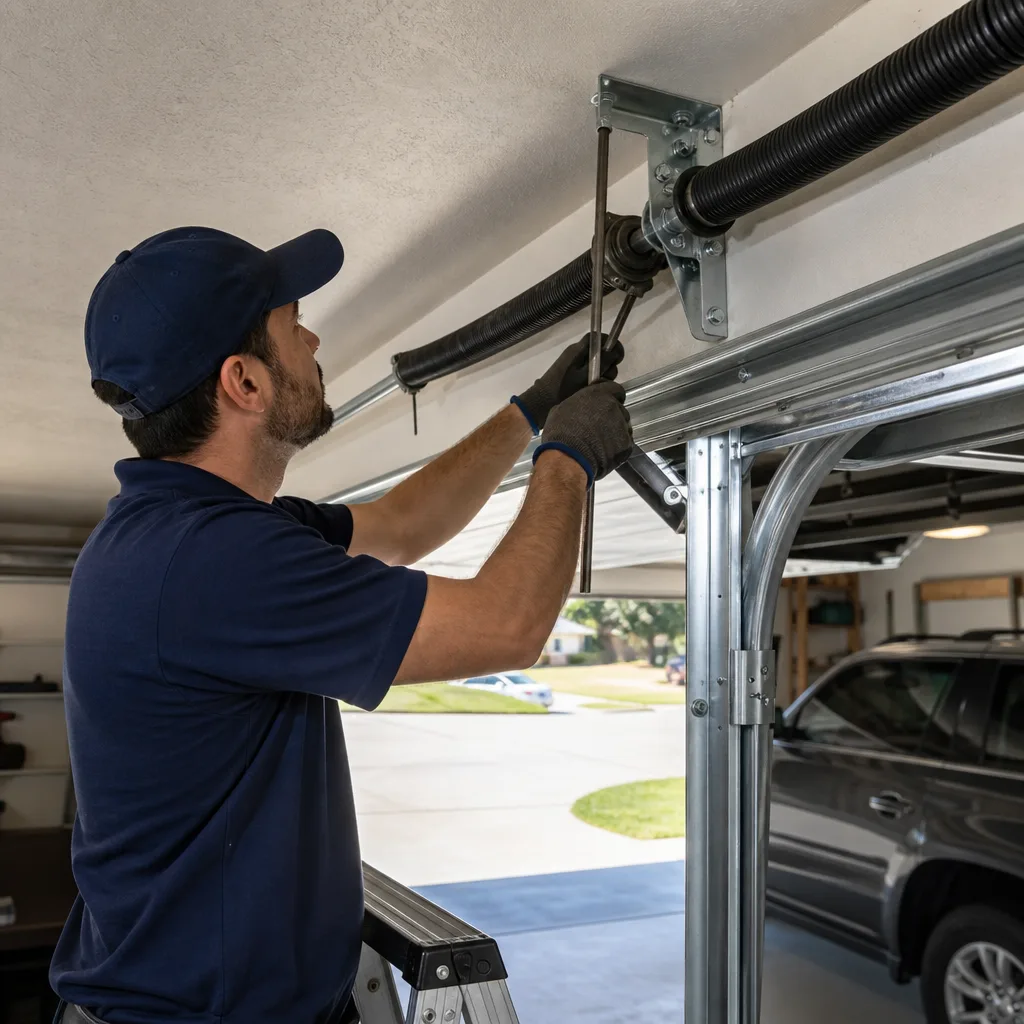
A loud pop or bang, especially when the door first lifts, signals a torsion spring with a failing coil. The spring is still working, but a section has lost tension and the remaining coils are overloaded. This is the most dangerous warning sign we encounter. Torsion springs store enough energy to cause serious injury or death if they release unexpectedly. We do not recommend any homeowner attempt to inspect or adjust a torsion spring. The popping sound means you have days to weeks before failure, not months. Call a professional immediately.
Slapping or Slapping-Bang: Loose Cable or Frayed Strand
A cable that has slipped from its drum or developed a frayed section will slap against the door panel or frame as the door moves. The sound is rhythmic, matching door speed. A frayed cable under tension can snap without warning. In League City’s humid air, cable corrosion accelerates, particularly for doors facing prevailing southeast winds off Galveston Bay. We’ve replaced cables in Bay Colony homes that showed advanced corrosion while inland Texas cables of the same age remained sound.
Scraping: Door Out of Alignment
Scraping indicates the door is rubbing against the track or frame, usually from a bent track, loose hardware, or a door that has shifted on its hinges. The scrape marks themselves become a diagnostic - fresh silver streaks on a painted door mean the condition is active and worsening.
Squealing: Dry Rollers or Hinges
High-pitched squealing is the least urgent sound, typically indicating dry nylon rollers or hinges. A silicone-based lubricant quiets it. But if lubrication doesn’t resolve the noise within two cycles, the roller may be worn rather than dry, and continued use will damage the track.
Visual Inspection: Rust, Wear, and Gulf Coast Damage
League City’s location 25 miles from the Gulf of Mexico creates conditions that shorten garage door component life, as detailed in The Complete Guide to Garage Door in League City. Salt air, humidity above 75% for much of the year, and occasional storm surge exposure mean visual inspection here carries more weight than in drier climates.
Surface Rust Versus Pitting: The Critical Difference
Surface rust appears as orange discoloration on springs, cables, and hardware. It can be cleaned and the component remains serviceable. Pitting - small craters in the metal surface - indicates the rust has compromised structural integrity. On a torsion spring, pitting means the coil is weakened at multiple points and will fail unpredictably. On lift cables, pitting creates stress concentrators where strands break internally before any external fraying becomes visible.
We inspect springs in League City homes that show pitting after 7-9 years, while identical springs in Houston’s drier western suburbs last 12-15 years. The difference is coastal exposure, not manufacturing quality. Homes in waterfront communities like South Shore Harbour or those on the bay side of Highway 146 see the fastest corrosion.
Cable Fraying: Where to Look
Inspect cables where they wrap around the bottom bracket and the drum at the top of the door. Fraying starts at these contact points. A cable with three or more broken visible strands, or any sign of “bird-caging” (localized bulging from internal strand failure), requires immediate replacement. Cables do not give a final warning - they snap when the remaining strands can no longer carry the load.
Hinge Cracks and Roller Wear
Steel hinges develop cracks at the knuckle where they pivot. A cracked hinge can separate, allowing the door panel to sag or bind. Nylon rollers wear flat where they contact the track; a roller that no longer turns freely but instead drags will destroy the track and increase opener strain.
Spring Coil Gaps
A torsion spring with visible gaps between coils when the door is closed has lost tension. The coils should sit nearly touching. Gaps indicate the spring has stretched and can no longer balance the door’s weight. The opener works harder, wears faster, and may eventually fail from the overload.
Slow or Uneven Movement: Reading the Mechanics
A garage door that moves slowly, hesitates, or travels unevenly is displaying a mechanical problem with a specific location. Which side lags, and when, points to the failed component.
Left Side Lags on the Way Up
If the left side of the door rises more slowly than the right, the left torsion spring has likely failed or the left lift cable is frayed and stretching. On a two-spring system, one spring can carry the load for a period, but the opener strains and the remaining spring fails prematurely from the overload. In League City, we see this pattern frequently in spring after winter humidity has accelerated corrosion on one side.
Right Side Drops Faster on the Way Down
A door that descends unevenly, with one side falling ahead of the other, indicates a broken cable or a seized roller on the slower side. The faster side is doing all the work. This condition stresses the door panels and can cause them to rack - twist out of rectangular shape - leading to permanent damage.
Overall Slowness: Opener or Door?
To distinguish opener problems from door problems, disconnect the opener and raise the door manually. A door that moves freely by hand but slowly under power has an opener issue: worn gears, failing motor, or incorrect force settings. A door that is heavy or binding manually has a spring, cable, roller, or track problem. This test takes 30 seconds and prevents misdiagnosed repairs.
The Manual Lift Test
- Close the door fully and pull the emergency release cord to disconnect the opener.
- Lift the door smoothly from the bottom to waist height.
- A properly balanced door stays at waist height without rising or falling.
- A door that falls closed has weak or broken springs. A door that rises on its own has excessive spring tension.
- Re-engage the opener by pulling the release cord toward the motor unit and running the opener to reconnect.
A door that fails this test puts continuous strain on the opener and will eventually burn out the motor or strip the drive gear. The cost of spring adjustment or replacement is typically half the cost of opener replacement.
The Door-Reversal Test and UL 325 Safety Standards
Since 1993, all garage door openers sold in the United States must comply with UL 325 safety standards, which require automatic reversal when the door encounters an obstruction. The 2018 revision strengthened these requirements. A door that fails the reversal test is not merely inconvenient - it is a safety hazard that can cause serious injury and exposes the homeowner to liability.
How to Perform the Reversal Test
- Place a 2×4 board flat on the floor, centered under the door path.
- Close the door using the wall button or remote.
- The door must reverse within 2 seconds of contacting the board and return to the fully open position.
- If the door stops but does not reverse, or continues to close, the safety system has failed.
What Failure Means
A door that fails the reversal test has one of three problems: misaligned or dirty safety sensors, incorrect down-force settings, or a faulty logic board. The safety sensors - the small units mounted 4-6 inches above the floor on each side of the door - must face each other with a clear line of sight. In League City, we find sensors knocked out of alignment by lawn equipment, children’s bikes, or the vibration of heavy garage use. Spider webs and dust accumulation on the lenses are common after spring pollen season.
A door that reverses before reaching the floor, with no obstruction present, indicates sensor misalignment or sunlight interference. South- and west-facing garages in League City’s afternoon sun are particularly susceptible. We install sun shields or reposition sensors to eliminate false triggers.
The down-force setting on the opener controls how much resistance triggers reversal. A setting too high means the door will crush an obstruction before reversing. A setting too low means the door reverses on normal seal compression. This adjustment requires a technician with a force gauge to set correctly per UL 325.
We document reversal test results on every Garage Door Repair in League City service call. If your door fails, we do not leave until it passes.
Weather Seal Failure: The Hidden Early Signs
Weather seal failure in League City progresses through predictable stages before water intrusion becomes obvious. Catching it early prevents floor damage, rusted door bottoms, and pest entry.
Stage 1: Hardening and Loss of Flexibility
The rubber or vinyl seal along the door bottom and between panels hardens with UV exposure and temperature cycling. A flexible seal compresses to fill gaps; a hardened seal leaves channels for air and water. Press the seal with your thumb - it should depress and rebound. If it feels like stiff plastic, it’s no longer sealing.
Stage 2: Cracking and Surface Checking
Fine cracks appear on the seal surface, running perpendicular to its length. These cracks open under door weight, creating leak paths. In League City’s intense summer sun, UV degradation accelerates this stage. We’ve replaced seals in Clear Lake area homes that showed advanced cracking after 4 years, while shaded doors lasted 8-10.
Stage 3: Warping and Deformation
The seal no longer sits flat against the floor. It may curl at the ends, bow upward in the center, or develop a permanent compression set that no longer springs back. Light visible under the closed door - check at dawn or dusk - confirms the seal is breached.
Stage 4: Water Intrusion and Floor Staining
By the time water enters, the seal has been failing for months. The concrete floor shows darkening, efflorescence, or rust stains from door bottom corrosion. In League City’s flat terrain with poor drainage in some subdivisions, even moderate rain can pool against the garage and force entry through a compromised seal.
Panel Seal Deterioration
The seals between door panels are often overlooked. These flexible strips prevent wind-driven rain from entering the door interior and corroding hinges and rollers from the inside. A seal that has pulled loose, shrunk, or crumbled allows water into the door cavity, where it accelerates rust on components that are never inspected.
Our $89 Seasonal Tune-Up includes seal inspection and replacement recommendation. For most League City homes, seal replacement every 5-7 years prevents the structural damage that follows neglect.
Opener and Electrical Warning Signs
Garage door openers give their own warnings before complete failure. Recognizing them prevents the door from stopping at the worst possible moment.
Intermittent Response to Remote or Wall Button
A door that sometimes responds to the remote and sometimes doesn’t may have a failing logic board, weak remote battery, or interference from LED light bulbs. The diagnostic step: does the wall button work reliably when the remote fails? If yes, the problem is likely the remote or receiver. If both are inconsistent, the logic board is failing. Logic board replacement costs $180-$280; a full opener replacement runs $450-$750 installed. We test both options and recommend the economical choice.
Motor Hums but Door Doesn’t Move
The opener motor runs but the door stays still. This usually indicates a stripped gear in the opener - the motor turns, but the drive mechanism no longer engages. The gear can be replaced, but if the opener is over 10 years old, full replacement is often more reliable. We carry LiftMaster, Chamberlain, and Genie units on our trucks for same-day installation when replacement makes sense.
Excessive Vibration or Shaking
An opener that vibrates excessively has loose mounting hardware, a failing motor bearing, or an unbalanced door that the opener is struggling to control. Vibration loosens the opener from its ceiling mount over time, creating a safety hazard if the unit detaches. We inspect mounting brackets and lag bolts on every service call.
Travel Limits Drifting
The door no longer stops at the same open or closed position. It may stop a foot short of full open, or close too hard against the floor. Travel limit potentiometers in the opener wear and drift. Modern openers with electronic limits rarely drift; mechanical limit switches on older units require periodic adjustment. Drifting limits also indicate opener age - if the mechanical system is worn, other failures follow.
LED Light Flickering or Failing
Opener lights that flicker or fail to illuminate may indicate a failing circuit board or loose connections. But first check: many modern LED bulbs create radio frequency interference that disrupts opener remote function. If you installed LED bulbs in the opener and then noticed remote problems, swap to incandescent or opener-compatible LED bulbs before calling for service.
Failure Timelines and Cost Consequences of Waiting
Each warning sign has a typical progression from first symptom to functional failure. Understanding these timelines helps League City homeowners budget and schedule repairs before emergency rates apply. For more guidance, see our How to Hire a Garage Door Contractor in League City: A Step-by-Step Guide.
| Warning Sign | Typical Time to Failure | Repair Cost Now | Repair Cost After Failure |
|---|---|---|---|
| Popping torsion spring | 3-14 days | $180-$340 (spring replacement) | $340-$580 (spring + damaged opener gear + possible panel damage) |
| Frayed lift cable | 1-4 weeks | $140-$220 (cable replacement) | $280-$450 (cable + track repair + possible door racking) |
| Grinding roller | 2-6 weeks | $120-$180 (roller replacement) | $280-$450 (roller + track replacement) |
| Failed reversal test | Immediate safety hazard | $0-$180 (sensor alignment or adjustment) | Liability exposure; injury potential; $450-$750 if opener replacement needed |
| Hardened weather seal | 6-18 months to water intrusion | $85-$180 (seal replacement) | $180-$400 (seal + door bottom rust repair + floor damage) |
| Intermittent opener response | 2-8 weeks | $180-$280 (logic board) | $450-$750 (full opener replacement if board unavailable) |
These cost ranges reflect League City’s market for professional garage door service, including parts and labor. The after-failure costs assume no additional damage to vehicles or property from a falling door or stuck-open situation.
Our Garage Door Installation in League City team sees the aftermath of delayed maintenance regularly. A door that receives prompt attention at the first warning sign typically costs 40-60% less over its lifetime than one run to failure.
Common Mistakes to Avoid
- Ignoring a door that needs two button presses. This is not an opener quirk. It is a safety sensor or logic board problem that will become a stuck-open door, usually at the least convenient time.
- Applying WD-40 to rollers and tracks. WD-40 is a solvent, not a lubricant. It removes existing grease and attracts dust, creating abrasive sludge. Use silicone spray or white lithium grease on garage door components.
- Attempting torsion spring repair after watching an online video. Torsion springs store lethal energy. We have responded to emergency calls in League City where a homeowner’s DIY attempt resulted in injury and additional damage. This is not a cost-saving strategy.
- Waiting for both springs to fail before replacing. On a two-spring system, when one spring breaks, the second is carrying double load and is near failure. Replace both; the labor is nearly identical and the door is properly balanced.
- Assuming surface rust is harmless. In League City’s coastal climate, surface rust on springs becomes pitting faster than inland homeowners expect. What looks minor in March can be structural failure by September.
- Neglecting the manual release cord test. Many homeowners have never pulled the emergency release. If the opener fails during a power outage or mechanical failure, you need to know the door moves freely by hand. Test it quarterly.
- Accepting “that’s normal for an old door” from a contractor. Age does not excuse grinding, shaking, or reversal failure. These are repairable conditions, and a contractor who dismisses them is either unqualified or planning to sell you a replacement you may not need.
When to Call a Professional
Call a professional immediately if you hear a loud bang from the garage, see a gap in a torsion spring, notice a frayed or separated cable, or if your door fails the reversal test. These conditions present genuine safety hazards that require trained technicians with the proper tools.
Schedule prompt service - within a few days - for grinding noises, slow or uneven movement, intermittent opener response, or visible seal deterioration. These problems worsen predictably and cost more when they fail completely. Browse our more guides & resources to stay ahead of repairs.
For routine concerns - a door that seems slightly louder than last year, or a seal that is beginning to harden - our $89 Seasonal Tune-Up provides full inspection, lubrication, adjustment, and a written condition report.
Mainspring Garage Door Co. offers free estimates in League City. Carl Dutton and our team answer the phone live, 24/7, including nights, weekends, and holidays. Call (936) 246-3131 to schedule. We arrive with springs, cables, rollers, and openers on the truck, and we state the flat price before any work begins. Most jobs are completed in a single visit.
Frequently Asked Questions
Garage door spring replacement in League City typically costs $180-$340 for a standard residential torsion spring, including parts and labor. A two-spring system runs $280-$480. We state the exact price before starting work, and every repair is covered by our 90-Day Done Right Promise. Call (936) 246-3131 for a free estimate.
You can safely lubricate rollers, hinges, and the opener chain or screw with silicone spray or white lithium grease. If the noise persists after lubrication, or if you hear popping, grinding, or slapping, the problem requires professional diagnosis. Do not attempt to adjust or replace springs, cables, or opener force settings yourself. Call (936) 246-3131 for a free estimate.
Test the safety reversal monthly using the 2×4 method described in this guide. Also test the photo-eye sensors by waving an object through the beam while the door closes - it should reverse immediately. In League City’s dusty, pollen-heavy environment, clean the sensor lenses quarterly with a soft cloth.
The safety sensors are misaligned, dirty, or receiving interference from direct sunlight. Check that both sensor LEDs are solid (not blinking), clean the lenses, and verify nothing blocks the beam. If the problem persists, the sensor wiring or logic board may be failing. We diagnose this condition at no charge with any service call.
Standard torsion springs are rated for 10,000 cycles (about 7-10 years of typical use). In League City’s coastal climate, salt air and humidity reduce this to 6-9 years for doors facing prevailing winds. We offer galvanized and coated springs that resist corrosion for homeowners in waterfront communities like South Shore Harbour.
No. Mainspring states the flat price before any work begins. If we discover additional problems during inspection, we explain them and quote separately. You approve every charge. There are no surprises on the bill. This is how we’ve operated since 1984.
The Bottom Line
Garage doors fail gradually, then suddenly. The grinding you hear today becomes the roller that destroys the track next month. The hardened seal you notice this spring becomes the water intrusion that rusts your door bottom by fall. In League City’s demanding coastal climate, these timelines compress.
The homeowners who avoid emergencies are those who recognize warning signs early, understand what they mean, and act before failure forces the issue. A $180 roller replacement beats a $450 track and roller job. A $89 tune-up that catches a frayed cable prevents the door that won’t open on a work morning.
We have served League City and the Gulf Coast for over 42 years. Our trucks carry the parts to finish most jobs in one visit. Our price is stated upfront. Our work is backed in writing for 90 days. If you recognize any warning sign in this guide, call (936) 246-3131 for a free estimate. We’ll tell you exactly what your door needs, what it costs, and when we can be there.
Written by Carl Dutton, Owner at Mainspring Garage Door Co., serving League City since 2016.